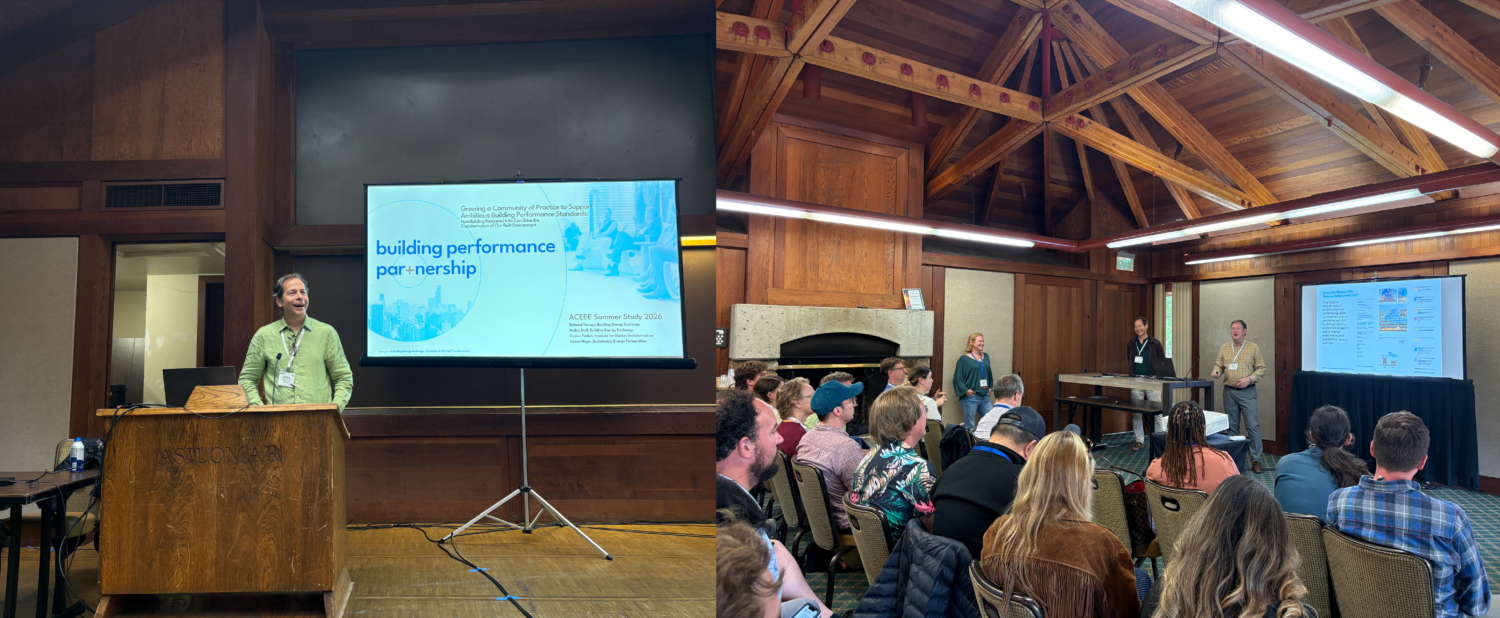
Chief Executive Officer Richard Yancey (left) and Senior Advisor to BE-Ex Adam Hinge (right) presenting at two featured formal sessions.
Every two years, the American Council for an Energy-Efficient Economy (ACEEE) hosts the Summer Study on Energy Efficiency in Buildings. This one-week conference takes place in Monterey, CA and brings together energy nerds from around the globe to present research, collaborate, and network to generate innovative ideas to help improve the efficiency, affordability, and resiliency of the building sector.
Building Energy Exchange (BE-Ex) co-authored three papers, presented at formal sessions, and participated in two informal sessions on other topical issues.
- LEARN MORE! Read about BE-Ex’s involvement at 2026 Summer Study in our other blog post.
- LEARN MORE! Read the papers co-authored by BE-Ex’s Richard Yancey and Hailey Moll:
-
- Decarbonization Planning for Affordable Multifamily Housing: Frameworks, Compliance Pathways, and Implementation Barriers
- Tall Building Deep Retrofits: Are We Making the Progress Needed, Or That We Think We Are?
- Growing a Community of Practice to Support Ambitious Building Performance Standards: How Building Resource Hubs Can Drive the Transformation of Our Built Environment
This year’s theme focused on efficiency innovation and improving affordability and resiliency within the built environment. Concerns over rising energy costs and affordability have become central in national discourse, as data center development faces increasing backlash from communities and state governments, and multi-decadal disinvestment in housing has placed many cities in a supply crisis.
The question on my, and most people’s, minds is: what can be done, and what is being done to tackle this?
Some of the brightest minds in energy, academic research, national labs, local governments, community outreach and engagement, utilities, tech, and sustainability gathered on the coastal Asilomar conference grounds to address this head-on. Over a week of conversations, collaborative workshops, presentations, and panel discussions, here is some of what I learned.
Reducing demand is paramount.
While electricity costs may inevitably rise with added load demand from data centers and electrification of our buildings, cars, and industries, we must prioritize solutions to shave peak demand, such as on-site renewables, battery storage, demand energy response, or thermal energy storage. Utility and public sector dollars are necessary to help incentivize building owners to invest in these technologies.
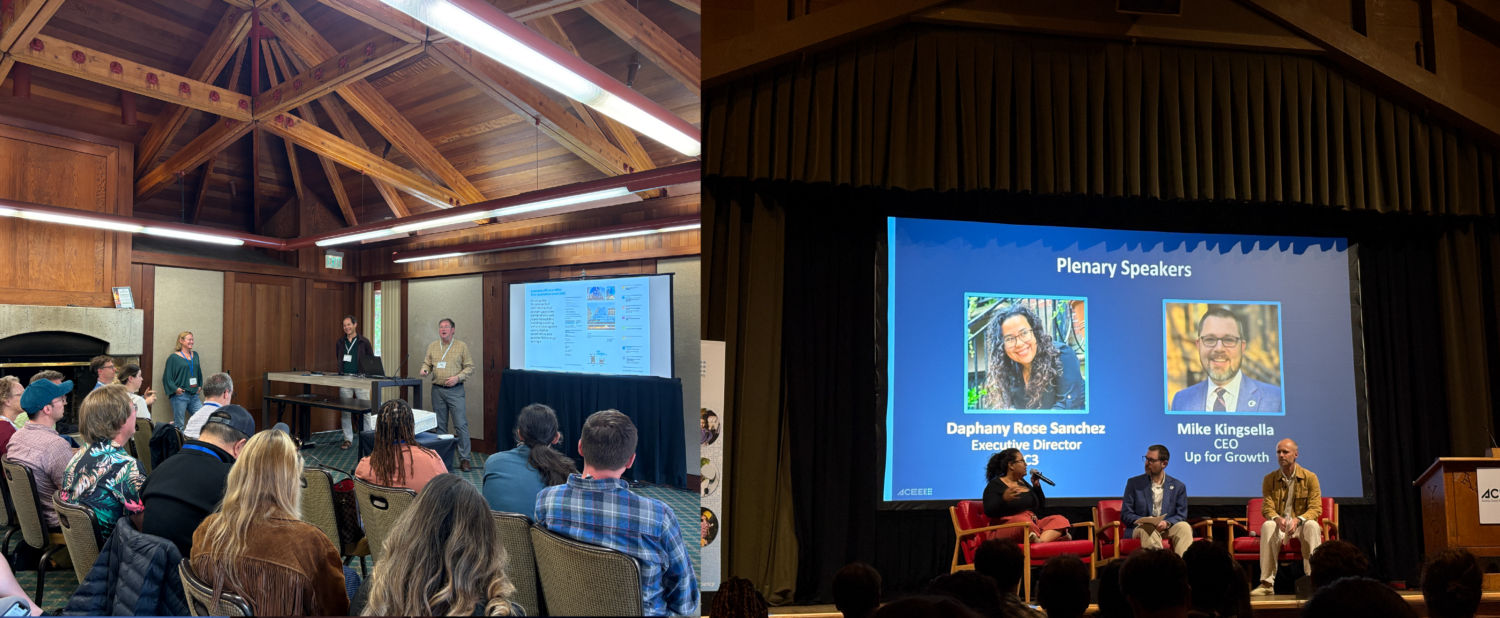
Affordability is not simply a cost issue.
Traditional energy efficiency programs treat affordability as merely a cost issue. To reduce operating costs, we could theoretically increase the rebates and incentives offered. However, this often faces too much political setback to become a reality. On the upfront cost-side, program administrators could improve their customer targeting to increase uptake. Yet, this tends to leave behind the high-need populations that stand to benefit the most from energy efficiency investments.Therefore, there are systemic barriers to addressing affordability issues that incentive programs alone cannot solve.
Innovative service delivery models, like DIY installs, alternative ownership structures like subscription models, or measured flexibility such as loaner programs, can make decarbonization more affordable by enhancing accessibility, minimizing risks, and avoiding trade offs.
Approach decarbonization at the neighborhood-scale.
There is a phenomenon observed in the adoption of residential solar known as ‘the peer effect.’ Often, when one household installs solar PV on their roof, neighbors become curious and intrigued to learn more. People are more easily convinced to invest in something when people they trust and who speak the same language share their experiences and positive outcomes.
We can utilize this peer effect to demystify decarbonization by approaching it at a neighborhood level. Implementing energy efficiency and electrification upgrades at an entire street block gets neighbors communicating with one another about how to use the new technology, the tangible benefits they witness, and other investments they can make in their community. Furthermore, neighborhood-scale decarbonization achieves economies of scale; Equipment can be bulk purchased, installations can be more coordinated, and community energy burdens are reduced.
Policy design can integrate an affordability focus.
While building performance standards (BPS) have the potential to decarbonize much of the existing building stock across the U.S., their implementation has imposed affordability challenges due to the high costs owners face to upgrade their buildings.
However, later adopters of BPS can thoughtfully design these policies to reduce upfront cost pressures whilst still moving towards a net-zero future. Some examples include utilizing energy burden or energy use intensity as the performance metric rather than strictly greenhouse gas emissions, or adding resiliency points to incentivize investment in climate adaptive community projects that improve an owner’s overall compliance standing.
Additionally, policymakers should ensure that the blueprint and return-on-investment from BPS programs are clear before imposing strict regulations on affordable housing. This will ensure that these buildings are not left behind in the energy transition but better supported by jurisdictional capacity and successful case studies.
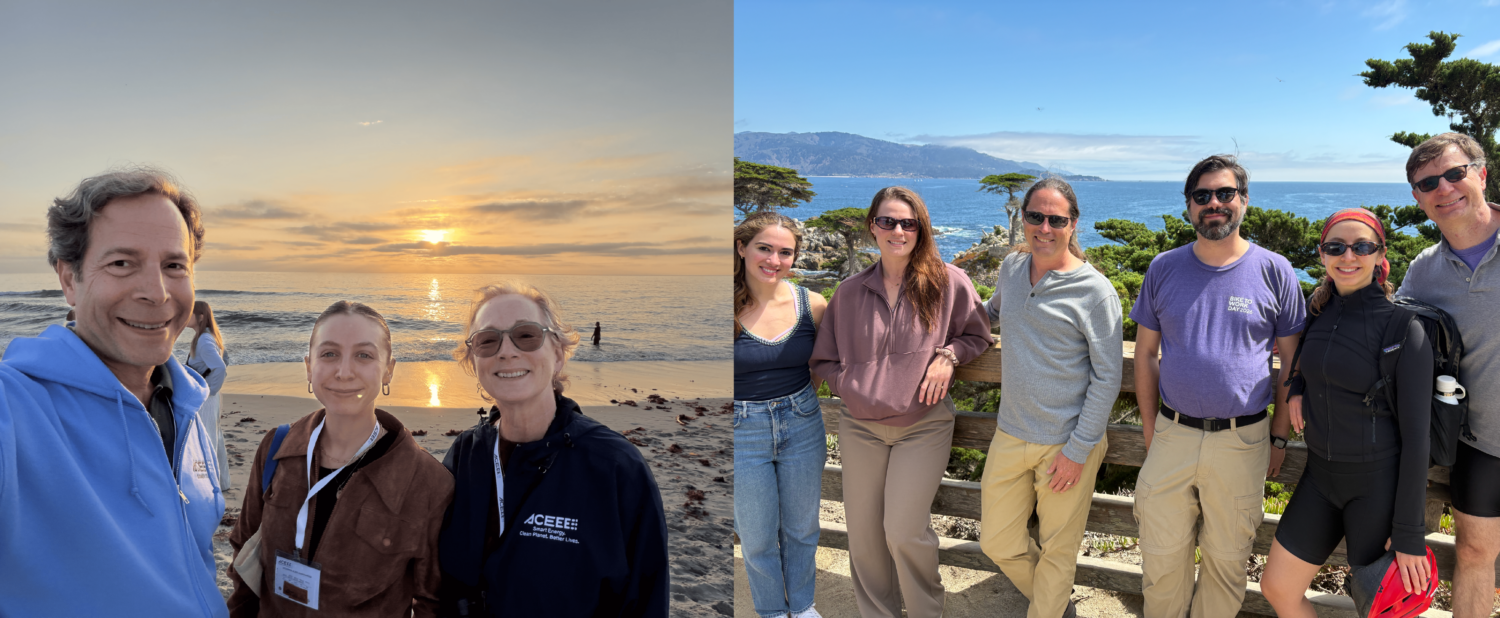
BE-Ex’s Richard Yancey and Hailey Moll (left) with members of the Institute for Market Transformation (right).
While no single, silver bullet was identified to resolve the dynamic and complex issues of climate change, energy efficiency access, affordability, or equity, one thing remains evident: we are more effective working together than we are alone.
At BE-Ex’s paper presentation on the Building Performance Partnership Network as a model for locally-mobilized national climate action, Chief Executive Officer, Richard Yancey, noted “It’s not whether we penalize people, nor whether we pay people; it’s whether we talk to people.”
At Summer Study, BE-Ex deepened existing relationships, forged new partnerships, debated critical issues, and gained valuable insights. I look forward to the continued collaboration and commitment from the dedicated practitioners in this industry to solve the most critical issues of our time, together.
Written by Hailey Moll, Manager, Educational Resources