Context
As part of New York’s ambitious climate policies, thermal energy networks have been identified as a key new policy and technology area to reduce fossil fuel use in building heating. In 2022, NY State passed the Utility Thermal Energy Networks and Jobs Act, which initiated the development of a new thermal energy utility service, with nearly $1 billion in potential pilot projects currently in planning or design.
Sweden has long been a sustainability frontrunner, implementing innovative and digitized thermal networks and waste heat recovery projects, and hosting one of the most established and deregulated district energy markets in Europe. Sweden is leading with advanced heat recovery from data centers and other waste heat, continuously improving and interconnected district networks. Sweden’s district energy success presents a major opportunity for knowledge exchange and collaboration between New York and Sweden, reinforced by our closely aligned climate objectives.
The Convenings
Building on a 2023 low-carbon building delegation to Stockholm, BE-Ex and the Swedish Energy Agency collaborated on two New York convenings of real estate and industry experts, in fall 2025, for an international knowledge-sharing roundtable on September 29, followed by a public panel on September 30. These events bridged perspectives from both sides of the Atlantic. Drawing on Sweden’s experience, participants discussed the challenges, opportunities, and viable pathways for scaling thermal energy networks (TENs) in New York, as state policy continues to drive development.

The Pamphlet
Assessing Thermal Energy Networks brings together insights from the broader Sweden–New York low-carbon exchange, key findings from the Fall 2025 convenings, and early perspectives on the path forward for TENs in New York, and a peak at what’s next for this international pathways series. It also includes additional context on the convenings themselves.
Preview the contents below.
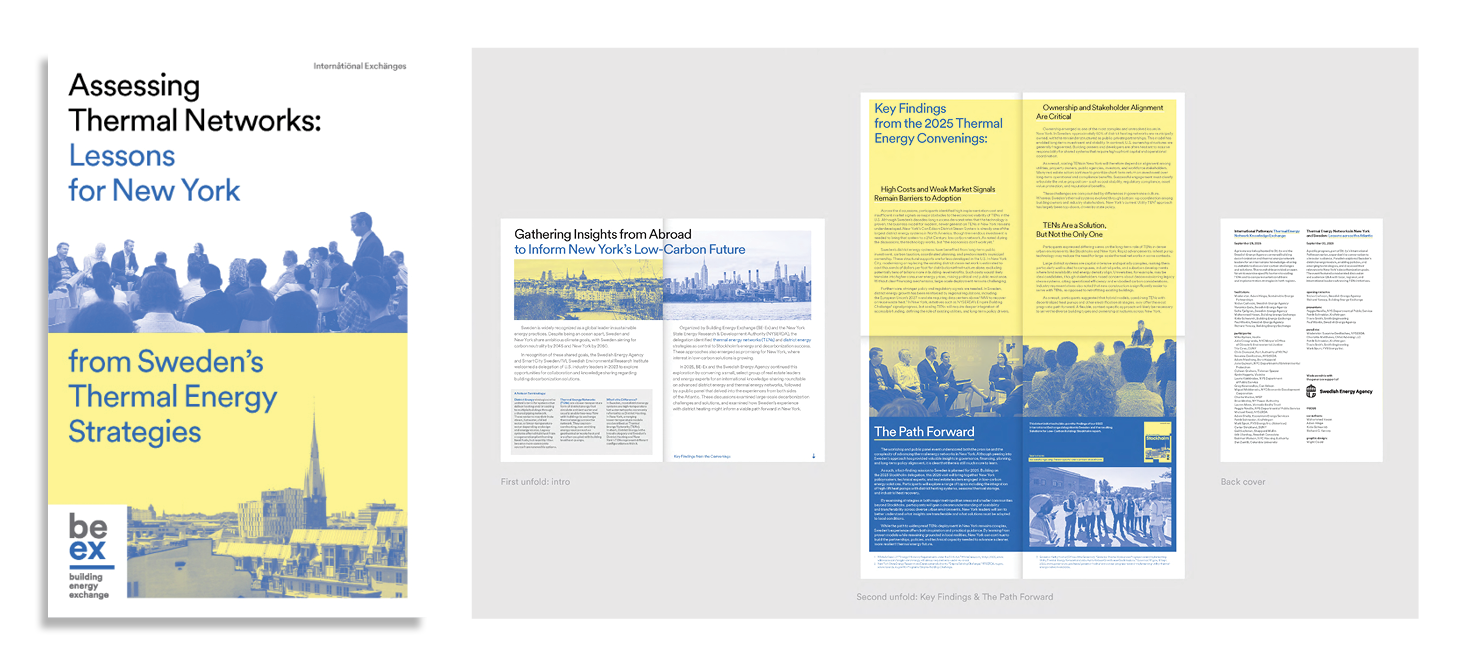
Key Findings
High Costs and Weak Market Signals Remain Barriers to Adoption
While the technology is proven, the financial and regulatory frameworks needed to scale deployment in New York are still evolving. High upfront costs and limited market signals continue to constrain adoption.
Ownership and Stakeholder Alignment Are Critical
Deploying thermal energy networks in New York will require coordination across utilities, property owners, public agencies, and investors. Unlike more established international models, local ownership structures remain fragmented, raising questions around responsibility, risk, and long-term return on investments.
TENs Are a Solution, But Not the Only One
Thermal energy networks offer a compelling pathway for decarbonization, particularly in certain building clusters. However, their role will vary by context, and in many cases, hybrid approaches may be more practical than a single system-wide solution.

The Path Forward
While the path to widespread TENs deployment in New York remains complex, Sweden’s experience offers both inspiration and practical guidance. As such, a fact-finding mission to Sweden is planned for May 18-20, 2026 composed of a delegation of New York policymakers, technical experts, and real estate leaders engaged in low-carbon solutions.
Project Team
Katie Schwamb, Building Energy Exchange
Richard C. Yancey, Building Energy Exchange
Mohammed Hasan, Building Energy Exchange
Adam Hinge, Sustainable Energy partnerships
This project was made possible with the generous support of the Swedish Energy Agency (SEA)